Platform connecting pet owners with trusted pet-care providers

Overview
Improving transparency throughout the pet-care booking lifecycle
TiriVelo is a pet-care platform that connects pet owners with providers for services like dog walking, daycare, and boarding. Working with a team of three designers, we evaluated the existing web experience and identified a gap in clarity after a booking request was submitted. My work focused on improving transparency throughout the booking lifecycle by clarifying booking states and restructuring messaging so users could better understand what was happening before, during, and after a service.
METHODS
Product audit
Journey mapping
Interaction design
Usability testing
Affinity mapping
Hi-fi prototyping
UX Researcher
ROLE
3 Designers
TEAM
USER PROBLEM
Pet owners had limited visibility into booking status and service progress after submitting a request, making it difficult to understand what was happening throughout the service lifecycle.
SOLUTION
Pet owners had limited visibility into booking status and service progress after submitting a request, making it difficult to understand what was happening throughout the service lifecycle.
KEY TAKEAWAYS
Pet owners lacked clear signals about booking status after submitting a request
Messaging tied to providers made it difficult to track conversations for specific services
Transparent service updates help reduce uncertainty during pet-care visits
Context
Identifying a gap in the post-booking experience
Our team began by reviewing the existing TiriVelo platform and previous work created by earlier design cohorts. While the platform supported the early stages of the user journey well, clarity decreased once a booking request was submitted.
At this stage of the experience, users lacked clear signals about:
Booking status
Service progress
Updates during the service
Completion of the visit
This gap created uncertainty during key moments of the service lifecycle, particularly when services were actively happening.
Early concept explorations of the Growth Path feature, testing different layouts and ways to present progress, milestones, and goal structure.
Research
Auditing the product and mapping the service lifecycle
Because the TiriVelo platform had been developed across multiple student teams, the first step was understanding the existing system. I conducted a product audit across owner and provider web and mobile to better understand how services progressed through the platform, I mapped journeys for both pet owners and providers from discovery through service completion. This exercise revealed that while discovery and booking were clear, visibility dropped significantly once the booking request was submitted.
Journey mapping helped identify gaps in visibility throughout the booking lifecycle.
KEY INSIGHT
Discovering a gap between daily habits and long-term goals
Limited visibility into booking status made it difficult for pet owners to understand what was happening throughout the service lifecycle.
How might we help pet owners clearly understand what is happening throughout the service lifecycle without adding unnecessary complexity to the interface?
Ideation
Designing the booking lifecycle experience
Based on these insights, I explored ways to improve how users track bookings and communicate with providers.
Early concepts focused on:
clearer booking cards and booking detail pages
stronger signals for booking status
improving how conversations were associated with services
Initially, messaging conversations were provider-based, allowing continuous communication across multiple bookings. While this supported long-term relationships with providers, it made it harder for users to connect messages with a specific service.
Early prototype exploring provider-scoped messaging, where conversations were organized around providers rather than individual bookings.
Iteration
Restructuring messaging to align with the booking lifecycle
During design review, the product owner raised concerns about provider-based messaging.
Conversations spanning multiple bookings made it difficult to associate communication with specific services, which could create challenges for reviewing service history or resolving disputes.
Based on this feedback, messaging was restructured to be booking-scoped, meaning each booking contains its own conversation thread tied directly to that service.
Because usability testing was scheduled the same week, I quickly revised the prototype to reflect the updated architecture.
Updated prototype after stakeholder feedback, introducing booking-scoped messaging where each service contains its own conversation thread.
Testing
To evaluate the redesigned experience, I conducted moderated usability testing with four participants.
Participants were asked to:
locate booking details
identify booking status
understand the messaging structure
interpret service progress and completion
Testing confirmed that booking-scoped messaging and clearer booking states improved users’ ability to track services.
Validating the booking experience
Affinity mapping used to synthesize usability testing insights and identify patterns in how users interpret booking status and service progress.
EVIDENCE
4/4 users understood booking-scoped messaging immediately
2/4 users identified bookings by provider name and date
3/4 users correctly interpreted booking states; some expressed uncertainty around Pending
2/4 users expected active services to be more visible
Impact–effort matrix used to prioritize design improvements based on usability testing insights.
DESIGN IMPROVEMENTS
Confirmed messaging structure aligned with user expectations
Emphasized provider identity and service dates within booking cards
Strengthened visual hierarchy and labeling for Pending
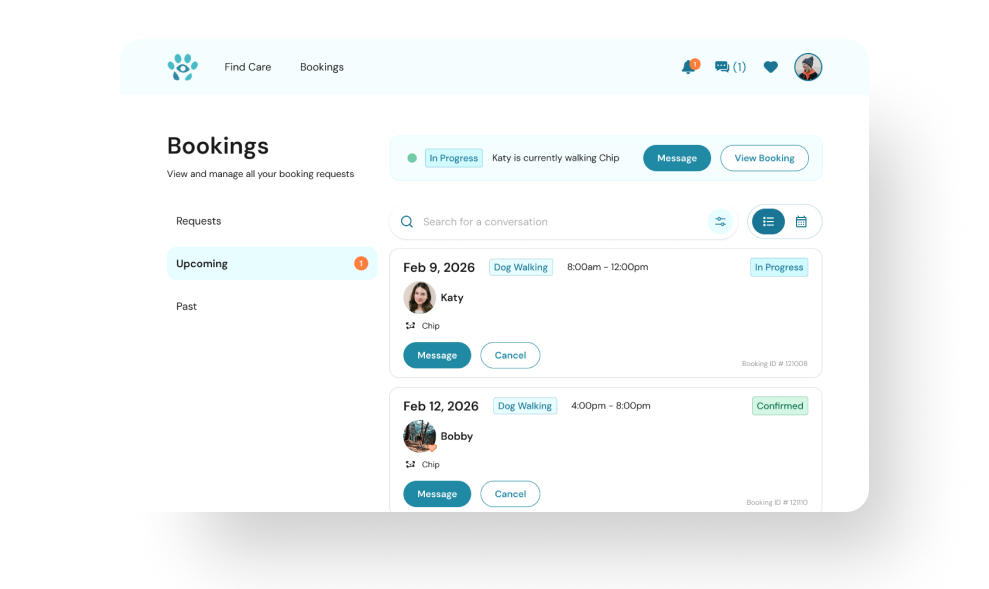
Introduced a Walk in Progress banner during active services
Solution
Improving transparency throughout the booking lifecycle
The final design improves visibility across key stages of the service experience. Together, these improvements create a clearer narrative of what happens before, during, and after pet-care services.
BOOKING LIFECYCLE STATES
Clear status indicators help users understand where their booking is in the service process.
BOOKING-SCOPED MESSAGING
Each booking includes its own conversation thread, ensuring communication stays tied to the correct service.
WALK IN PROGRESS BANNER
A clear signal appears when a service is actively happening.
ACTIVITY LOG
Booking details include a timeline of updates such as schedule changes and provider actions.
CARE REPORTS
Completed services include a summary of the visit.
Handoff-Ready User Flow & Interaction Callouts
This handoff file outlines the end-to-end booking and messaging experience, mapping key user flows, booking states, and interaction patterns across the lifecycle. It highlights how users move from booking requests to completed services, while documenting critical moments such as status transitions, messaging behavior, and schedule updates.
Annotated callouts provide context for design decisions, ensuring engineers and future teams can clearly understand system behavior, edge cases, and how each state supports transparency and continuity throughout the experience.
Reflection
Designing within an existing product system
This project taught me how to design improvements within an existing product ecosystem rather than starting from scratch.
Because the platform had evolved across multiple student teams, it was important to evaluate what should be improved, preserved, or simplified within the system.
The project also reinforced how critical transparency is in service-based platforms. Clear signals around booking status and service progress can significantly reduce user uncertainty and improve trust in the service experience.
FUTURE ITRATIONS TO EXPLORE
Real-time service updates during active bookings
Expanded care reports with photos and notes
Structured provider updates during services
See more case studies
Annwn case study
Digital oracle for reflection and personal insight