Digital oracle for reflection and personal insight

Overview
Designing a calm digital space for reflection during everyday moments of uncertainty
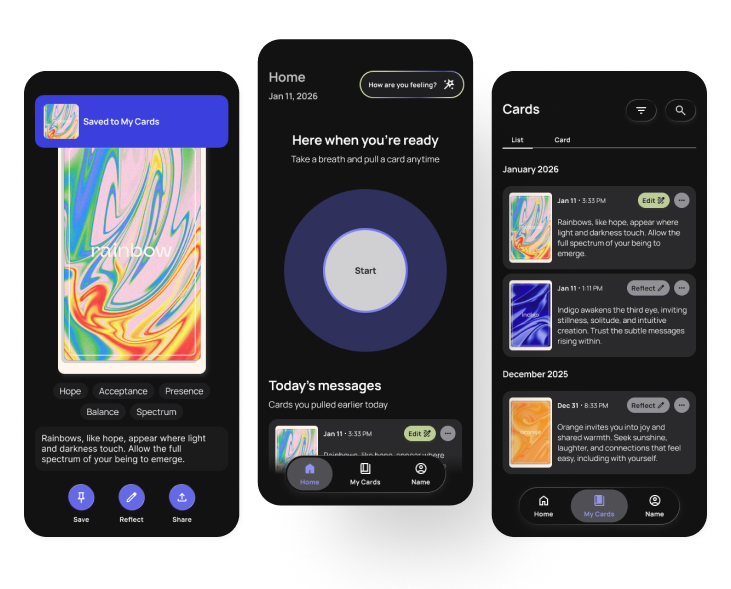
Annwn is a digital oracle and reflection app designed to support people during moments of anxiety, transition, or uncertainty. While physical oracle card decks are meaningful tools for reflection, they often require time and ritual that aren’t always available in everyday life. Through user interviews, interaction design exploration, and usability testing, I designed Annwn as a lightweight companion experience that helps users pause, pull a card, and reflect in moments when they need guidance but lack the time or space for a full practice.
METHODS
User interviews
Competitive analysis
User flows
Usability testing
Affinity mapping
Low & hi-fi prototyping
UX Researcher
Product Designer
ROLE
USER PROBLEM
How might a digital experience support moments of reflection without replacing the deeply personal ritual of physical oracle practices?
SOLUTION
A high-fidelity prototype featuring a guided card pull and reflection library, designed to support quick, meaningful reflection in everyday contexts.
KEY TAKEAWAYS
Oracle practices are meaningful but often require more time and ritual than everyday life allows
Designing for emotional contexts requires flexibility and user agency
A lightweight digital experience can complement physical reflection practices with quick guidance
Context
Designing intuitive support during moments of uncertainty
Annwn was designed as a gentle digital companion for moments when users need a pause or moment of reflection.
Rather than replacing physical oracle decks, the goal was to explore how a digital experience could support quick, accessible reflection during everyday life, especially when traditional practices feel impractical.
The product concept centers around a simple interaction loop:

Research
Understanding how people use oracle tools in real life
To understand how people currently engage with oracle practices, I conducted interviews with five experienced oracle and tarot users. Participants described their practices as deeply personal and meaningful, but also time-intensive and context-dependent. Many users explained that while they value their decks, real-life moments of uncertainty often occur in environments where a full ritual isn’t practical.
EVIDENCE
5/5 users described oracle decks as meaningful tools for personal reflection
4/5 users shortened or skipped reflection when they were busy or away from home
3/5 users said journaling often required 30–90 minutes of uninterrupted time
Affinity map organizing interview insights around time, ritual, and moments when users seek guidance.
I usually just receive a message, and then I just go on with my day. Especially when I do it for myself.
— Participant 1
“Sometimes if I’m going to that deck, I might go to that deck just for a quick reading… I just go straight to the guidance.”
— Participant 2
“I haven’t journaled in so long, because when I pull oracles it takes at least 30 minutes… when I journal it can take over an hour.”
— Participant 3
KEY INSIGHT
Discovering a gap between meaningful rituals and everyday contexts
Research revealed that users don’t want an app to replace their oracle decks. Instead, they want something lightweight and accessible that fits naturally into everyday life when their usual practices aren’t available.
This led to a key design opportunity:
Design a complementary experience that supports reflection in moments when physical tools aren’t accessible.
Three guiding principles shaped the product direction:
Emotional safety — The experience should feel calm and non-judgmental
Flexibility — Users should engage at their own pace
User agency — The app should support reflection without prescribing meaning
I analyzed existing tarot, astrology, and reflection apps to understand how they support emotional insight, ritual, and self-reflection.
Labyrinthos
Mystic Mondays

Reflection
Co-star


KEY TAKEAWAYS
Experiences are often either ritualistic or analytical, not both
Tarot and astrology apps create engaging daily rituals, while journaling tools focus on structured reflection, but few bridge emotional intuition with guided insight.
Emotional tone and delivery can feel misaligned
Some experiences feel too blunt, overwhelming, or impersonal, highlighting an opportunity for more gentle, supportive, and emotionally aware interactions.
Users are left without support after moments of insight
Many tools provide daily readings or prompts, but lack guidance on how to process or apply that insight in a meaningful way.
PERSONA

Designing for individuals seeking emotional reassurance in moments of uncertainty
Avery uses oracle and tarot cards as a source of comfort during periods of stress or self-doubt. She’s not looking for answers or predictions, but for gentle reassurance and emotional grounding that helps her feel supported without becoming overwhelmed.
How might we help Avery feel calm and reassured during moments of uncertainty while supporting emotional safety and self-trust?
Ideation
Designing gentle interaction flows for reflection
Based on these insights, I explored interaction flows that support quick reflection while maintaining a calm and intentional experience. This led to two core features designed to help users pause, pull a card, and reflect without pressure. Both flows prioritize low cognitive load and avoid rigid structures like streaks or performance metrics, allowing users to engage with reflection at their own pace.
GUIDED CARD PULL
A simple flow that invites users to pause, pull a card, and receive a reflective message designed to support moments of uncertainty.
REFLECTION LIBRARY
A personal space where users can revisit past card pulls and reflections, helping them notice patterns and reconnect with meaningful insights over time.
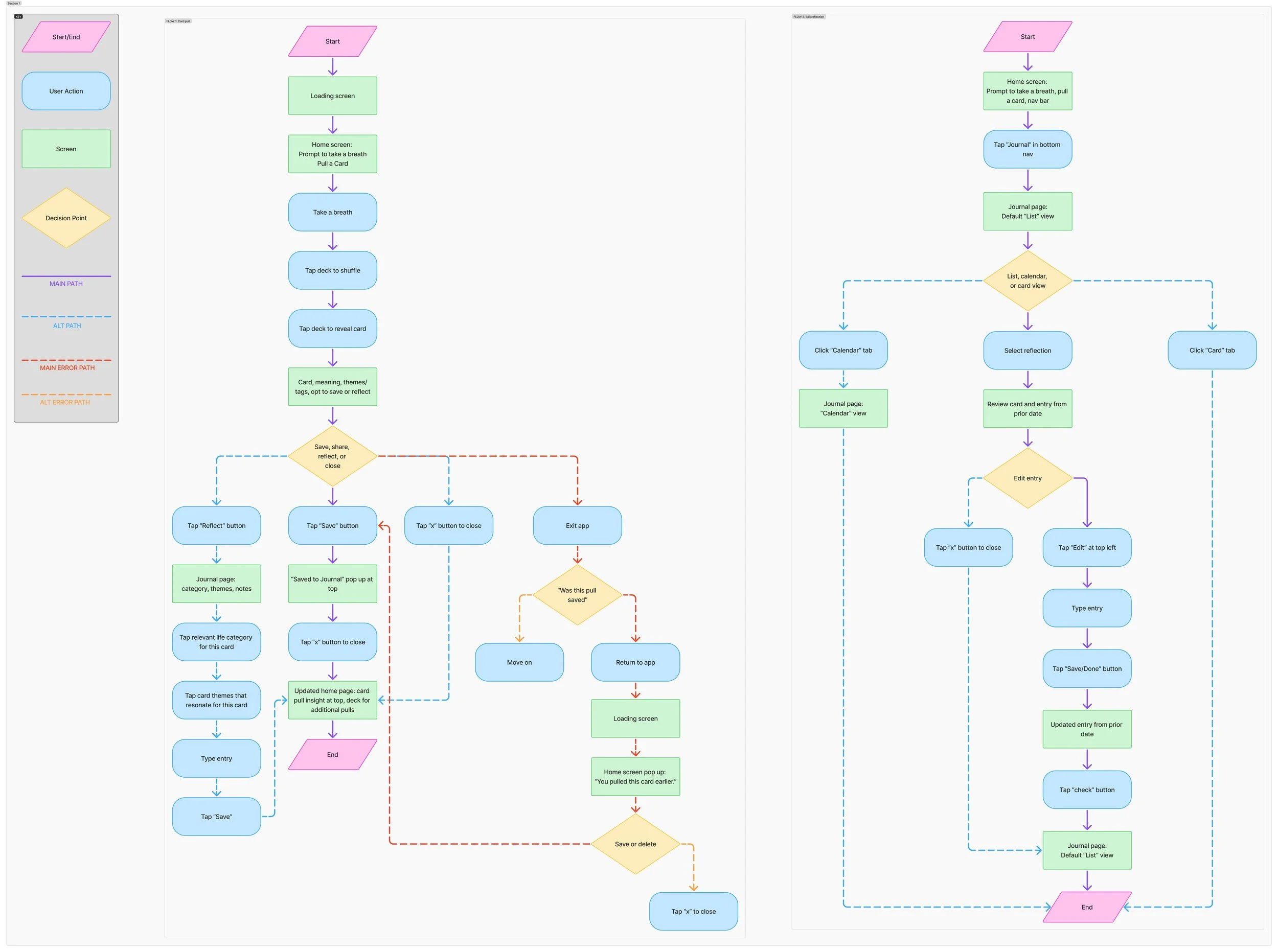
Two flows outline the card pull and journaling experiences, showing how users move between quick guidance and deeper reflection in a lightweight, flexible way.
Early sketches exploring the structure of the guided card pull and reflection experience.
Iteration
Exploring layout and hierarchy across key screens
I explored multiple layout directions side by side to test how information, actions, and navigation could be structured across key screens. These variations were reviewed with my mentor to evaluate clarity, hierarchy, and ease of use.
Elements from the top row informed the final design, particularly around how actions and content are grouped. For the home experience, we aligned on the second option for its clearer focus and more intuitive flow.
Testing
Testing how the experience feels during moments of stress
I tested low-, mid-, and high-fidelity prototypes to understand how users navigated the experience and how the tone felt during emotionally activated moments. Testing focused on clarity, pacing, and emotional comfort.
EVIDENCE
5/5 users valued the guided pause before pulling a card
3/5 users felt overwhelmed by heavy onboarding instructions
5/5 users valued the ability to revisit past reflections
3/5 users preferred open-ended reflection prompts over structured questions
DESIGN IMPROVEMENTS
Added a short guided breath before the card pull
Simplified onboarding and moved guidance into optional moments
Prioritized the reflection library for revisiting past insights
Rewrote prompts to feel softer and more interpretive
Visual Design
Designing a visual system that supports calm, reflection, and emotional safety
I developed a visual system to reflect the emotional tone of the experience, focusing on calm, clarity, and gentle guidance. Through soft gradients, minimal UI, and atmospheric visuals, the interface creates a sense of quiet presence, supporting reflection without adding pressure or cognitive load.
Exploring visual references that evoke calm, softness, and emotional presence through light, gradients, and minimal design.
Building a flexible UI system that supports clarity and consistency while maintaining a calm and unobtrusive visual language.
Solution
Creating a calm digital companion for reflection
The final Annwn prototype provides a calm, supportive reflection experience designed for everyday moments of uncertainty. The experience includes a guided pause, a simple card pull interaction, open-ended reflection prompts, and a reflection library for revisiting past insights. Together, these features prioritize emotional safety, user agency, and gentle pacing, allowing users to engage with reflection in a way that feels natural and optional.
Reflection
Designing for emotional context in digital products
This project reinforced the importance of designing for emotional context. Moments of uncertainty often occur when users are busy, distracted, or overwhelmed, requiring experiences that reduce friction while still feeling thoughtful and supportive. Annwn explores how digital tools can complement meaningful reflection practices by offering a lightweight companion for everyday moments.
FUTURE ITRATIONS TO EXPLORE
Testing the app in on-the-go contexts
Expanded card deck personalization
Long-term reflection insights
See more case studies
Finch case study
Gamified self-care and mental health app